Crystals & Feng Shui: How To Create Alignment Within Ourselves And The Space We Live In
Crystals & Feng Shui: How To Create Alignment Within Ourselves And The Space We Live In
For centuries, if not millennia, Feng Shui and crystals have both been used to create greater harmony and wellbeing. Although they come from different traditions, they share a common goal: helping us feel more aligned with ourselves and the spaces we inhabit.
The purpose of using Feng Shui is to create an environment that supports health, wellbeing and balance.
In Classical Feng Shui, every property has its own energetic blueprint. Using compass directions and the building’s orientation, practitioners divide the home into nine sectors, each representing different qualities of life.
A skilled practitioner will run different technical models to come up with suggestions and solutions for residents’ everyday living. Just as crystal healers are trained to assess the energy field of a person, a Feng Shui practitioner assesses the types of energies within a home. These energies are segmented into 9 home sectors, also called guas, which together form a bagua map. This map can be superimposed onto your floorplan, with the point of entry based on the compass orientation of your property. The main orientation of a property is called the “Facing”. If the main door of the Facing sits in the middle of the house, as shown in the map below, then your starting point is the North.
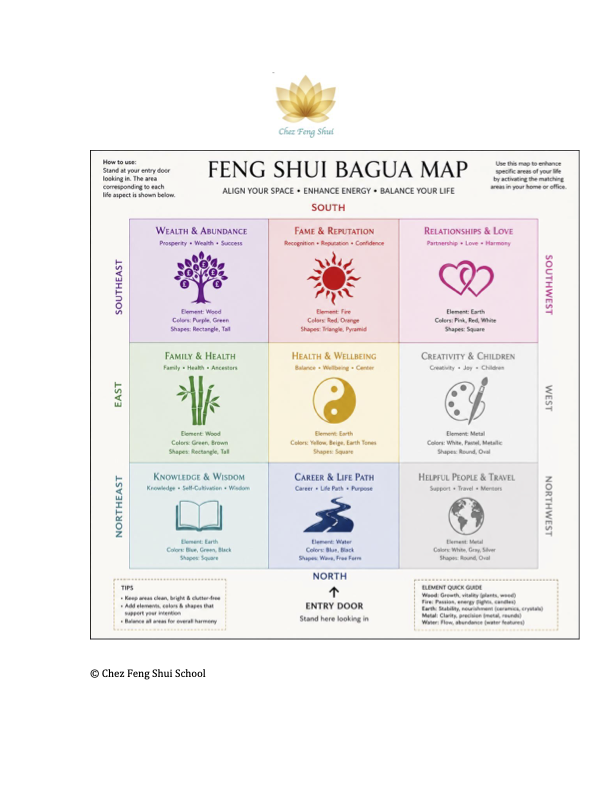
As crystal healers, we can meditate on the vibration and meaning of, for example, the North sector of our home, and place the crystals that resonate most with that area.
What matters most is first allowing qi to circulate freely throughout your home. This is done by keeping passageways clutter-free and allowing natural light to penetrate, particularly in the yang areas of the home (mainly living areas, hallways, and the office).
I encourage all of us to tune into each bagua and choose crystals that harmonise with the room, in the same way we would when doing healing work on someone. A home has a natal blueprint at the moment of its birth, when the house was built, or when the residents moved in. Just as every individual has a unique energetic blueprint, so does every home. Feng Shui considers the orientation and the time a property came into use to understand how its energy evolves over time.
Every year, that blueprint (based on orientation and floorplan) receives energies in different parts of the house, known as “annual flying stars”. This is why a Feng Shui consultation is never static. Just as we change throughout life, so do our homes. These shifts in vibration can intuitively encourage us to move small things around our home each year, furniture placement, décor, and crystals included. These changes can be minimal: moving a plant to a new spot, for instance, or adding more metal frames or metal décor to a specific room.
You might wonder what effect a crystal has, depending on where it sits in your home. Every crystal emanates its own vibration, based on the family it belongs to (quartz, plant, calcite, feldspar, beryl, corundum, and so on), its crystalline structure (cubic, hexagonal, tetragonal, orthorhombic, monoclinic, and so on), its colour, and its mineral composition. All of these elements contribute to its unique vibration.
Beyond bagua placement, individual crystals also carry their own vibration worth understanding on its own terms. Where would you use black tourmaline, for instance? Black as a colour is absorbing, and tourmaline has piezoelectric properties, meaning it reacts to heat and pressure. Black tourmaline has long been associated with grounding and protection. Many crystal practitioners choose to place it near electronic equipment because it symbolises stability and helps create a sense of energetic grounding.
In Feng Shui, each gua welcomes certain energies and is traditionally associated with specific crystals. You can see this crystal allocation in the map below. The Southeast sector, traditionally associated with prosperity and abundance, naturally complements crystals such as citrine and amethyst.
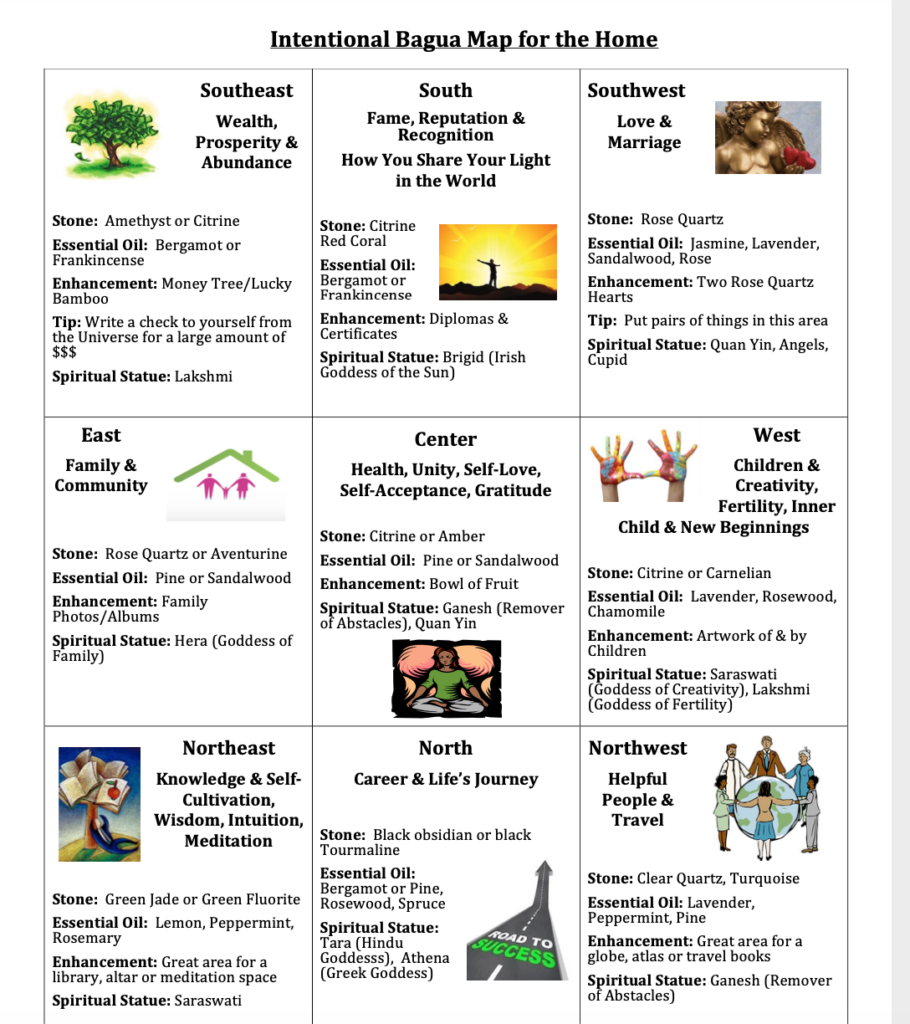
While the bagua map offers one way to think about crystal placement, I have a slightly different perspective, preferring to focus on specific rooms instead. For example, when coming into your home, I would place a nice amethyst in the entryway. To me, amethysts are protective and invite sobriety, warding off aggressive or overstimulating behaviour. A clear quartz would be welcome in the living room and office for its reflective properties, exuding focus and yang energy.
In the bedroom, we of course have the classic rose quartz — nurturing, forgiving, and bonding. In Feng Shui, we like to have things in pairs in the bedroom, such as two matching nightstands or a pair of identical lamps, to invite parity and unity.
Ultimately, Feng Shui and crystal healing are not about perfection or following rigid rules. They invite us to become more aware of the relationship between ourselves and the spaces we inhabit. When our homes feel balanced, we often feel more balanced too. Sometimes the smallest changes, a thoughtfully placed crystal, a decluttered hallway, or simply bringing more light into a room, can gently transform how we experience our everyday lives.
Good Feng Shui is when we feel aligned with our homes, and in return, this alignment nurtures our awareness of self and space.
Alexandra Berthault
chezfengshuilondon@gmail.com